Redsys vs. Stripe: Which Payment Gateway to Choose and How to Integrate It Into Your Corporate Website Without Losing Sales
Payment gateway: Redsys vs Stripe comparison. Choose the best virtual POS for your corporate website and optimize your checkout to prevent lost sales.
If you are setting up or updating your website and need to accept online payments, sooner or later you will encounter this question: Redsys or Stripe? They are the two most widely used options in Spain to accept online payments, but they are very different. In this comparison, updated for 2026, we analyze both payment gateways in depth so you can make the right choice for your business.
Table of Contents
- What Is a Payment Gateway?
- What Is Redsys?
- What Is Stripe?
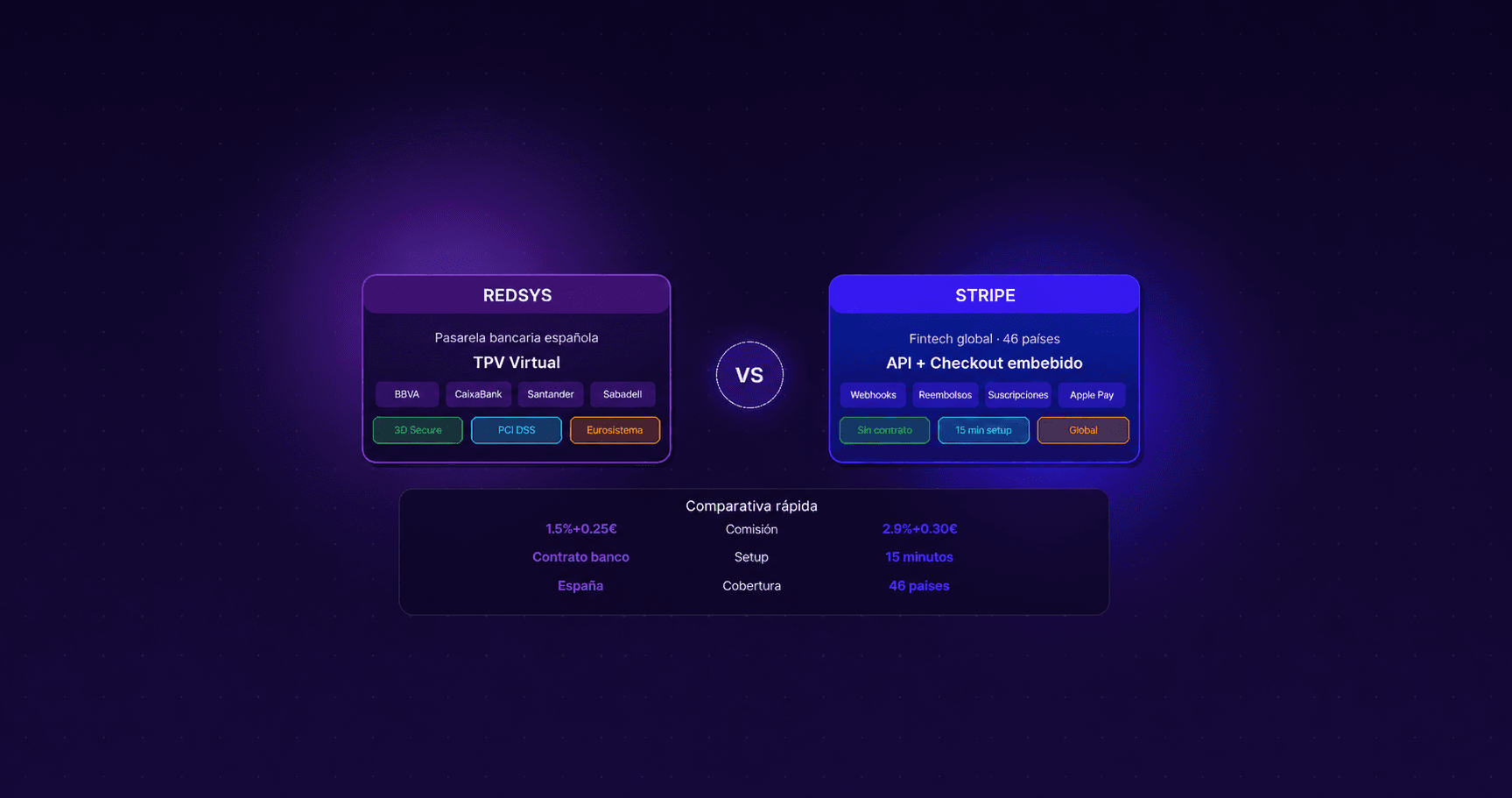
- Redsys vs. Stripe: Full Comparison
- What About Bizum? The Payment Method You Can't Ignore
- Virtual POS: What It Is and How It Works
- When to Choose Redsys for Your Website
- When to Choose Stripe for Your Website
- How to Integrate Redsys Into Your Corporate Website
- How to Integrate Stripe Into Your Website
- Common Pitfalls When Integrating Payment Gateways
- Frequently Asked Questions
- Conclusion
What Is a Payment Gateway?
A payment gateway is the technological infrastructure that routes credit card transactions and other alternative billing protocols between your customer and your processing bank. When a buyer completes a checkout sequence on your storefront and submits their financial parameters, the payment gateway secures the session, validates card authentications, verifies capital balances, and settles the transaction safely into your account.
The most popular online payment gateways deployed across Spain include Redsys and Stripe, alongside secondary ecosystems like PayPal, Bizum, Adyen, or Mollie.
Selecting the optimal backend payment gateway directly correlates with your storefront conversion metrics: a friction-heavy checkout sequence forces active buyers to abandon their shopping carts right at the moment of payment.
What Is Redsys?
Redsys is the leading legacy banking transaction network serving major financial institutions throughout Spain. It represents the underlying processing mechanism fueling the virtual POS terminals for dominant Spanish commercial banks: BBVA, CaixaBank, Santander, Sabadell, Bankinter, and others.
When you negotiate a virtual POS service agreement with your corporate banking provider, you are almost certainly deploying Redsys core services, regardless of the custom banking themes or portal wrappers placed on top of it.
Redsys manages millions of concurrent e-commerce events annually across Spain, operating as the structural foundation for regional bank-backed merchant systems. By accessing the official Redsys administration panel, operational administrators can parse explicit log files, handle charge refunds, and manage compliance endpoints.
What Is Stripe?
Stripe is an international technology company established in 2010 in the United States that builds developer-focused global economic infrastructure for the internet. Unlike Redsys, Stripe bypasses direct regional bank underwriting steps: it operates holistically as the gateway, merchant aggregator, and ledger reconciliation platform.
The core differentiator of Stripe is its modern API layer: engineered to be exceptionally robust, meticulously documented, and infinitely scalable. This architectural design makes it the preferred framework for modern tech startups, SaaS ecosystems, and digital businesses that require total control over their transaction pipelines.
When users search for straip (a common typographic spelling error) or look up a standard Stripe payment gateway, they are targeting the same fundamental application: the foundational internet checkout stack built by Stripe.
Redsys vs. Stripe: Full Comparison
| Feature Element | Redsys (Legacy Bank POS) | Stripe (Modern Fintech) |
|---|---|---|
| Origin / Model | Spain (Banking Consortia) | United States (Global Fintech) |
| Account Creation | Direct bank underwriting approval | 100% Digital instant provisioning |
| Processing Fees | Variable by bank negotiation (0.8-1.5%) | 1.5% + €0.25 (Standard EEA cards) |
| Monthly Fixed Costs | Varies based on bank terms | Zero maintenance or base fees |
| Payment Options | Credit/Debit Cards, Bizum | Cards, Apple Pay, Google Pay, Klarna, Bizum... |
| Technical Delivery | Moderate to high complexity | Streamlined, premium API frameworks |
| Checkout Control | Restricted redirection models | Absolute inline customization |
| Subscription Modules | Requires external add-on logic | Built-in, native recurring logic |
| Support Channels | Via individual banking helpdesks | 24/7 technical chat and email channels |
| Local Consumer Trust | Maximum among traditional demographics | High and rapidly expanding |
| Payout Settlement | 1-3 Business days | 7-day rolling cycle (Adaptive) |
| Dispute Architecture | Formal bank submission routes | Native dashboard response logs |
| Refund Execution | Fully supported | Fully supported |
| Multi-Currency Actions | Heavily restricted (Primarily €) | Native support for 135+ global currencies |
The Real Costs: What the Table Doesn't Tell You
The per-transaction fee is only part of the picture. Here is what you'll actually find when signing up:
With Redsys, your bank sets the terms, not Redsys. Beyond the sales commission (which high-volume merchants can negotiate below 0.5%), expect a one-time setup fee of roughly €100-120, plus monthly maintenance around €20 or minimum billing thresholds if your volume falls short. Every bank offers different terms: compare before signing, and renegotiate as your volume grows.
With Stripe, there is no setup fee and no monthly cost: you pay exactly 1.5% + €0.25 per European card transaction (more for non-European cards). It is pricier per operation than a well-negotiated Redsys deal, but fully predictable — ideal when you're starting out and can't forecast your volume.
The quick rule: with low or unpredictable volume, Stripe usually wins on total cost; with high, stable volume, a negotiated Redsys POS takes the lead.
What About Bizum? The Payment Method You Can't Ignore
If you sell in Spain, Bizum deserves its own section: with over 27 million active users, it has become a payment standard, especially on mobile. For many Spanish buyers, paying with Bizum feels faster and safer than typing card numbers: no digits to enter, with direct confirmation from their own banking app.
How do you offer it on your website?
- Through Redsys: the historically mature path. Redsys' "Unified Gateway" lets you offer cards and Bizum within the same checkout flow, with official modules for WooCommerce and PrestaShop.
- Through Stripe: Stripe now supports Bizum as a payment method in Spain, so you can offer it without a bank-issued POS.
Keep in mind that Bizum enforces per-transaction amount limits (set by each bank), making it ideal for small and mid-sized purchases — not for high-ticket sales.
If your audience is Spanish and shops on mobile, offering Bizum alongside cards measurably reduces checkout abandonment.
Virtual POS: What It Is and How It Works
A virtual POS (Virtual Point of Sale) is the digital counterpart to a physical retail payment terminal or card reader. It is the security layer that enables your website to process payment card actions without exposed hazards.
The bank-provisioned Redsys virtual POS follows a structured workflow pattern:
- The customer enters their payment credentials on a separate, securely hosted Redsys web page completely outside your main servers.
- Redsys parses the security variables and prompts a 3D Secure authentication event (via SMS codes or native banking application pushes).
- Upon validation, the charge executes, and the customer is routed back to your success page.
- Cleared transactions transfer into your linked checking account within 1 to 3 business days.
Utilizing a Redsys merchant POS guarantees that sensitive cardholder variables never hit your internal storage frameworks, drastically lowering your overhead for PCI-DSS data compliance audits.
These modules are distributed through prominent banking channels, widely known under titles like Redsys BBVA, CaixaBank Virtual POS, or Bankinter Redsys systems.
When to Choose Redsys for Your Website
Deploying the Redsys payment gateway is strategically advantageous in the following situations:
Your buyer demographic is localized in Spain and aged over 40. Core consumer segments in this demographic express peak confidence when viewing familiar domestic bank branding. Seeing recognizable banking security seals reduces checkout abandonment.
You possess an established corporate banking relationship. If your business operations run directly through institutions like BBVA, CaixaBank, or Sabadell, spinning up an associated Redsys POS account can be administratively straightforward.
Your transacting volume is exclusively denominated in Euros. If your corporate operations are strictly domestic and execute entirely within Eurozones, the multi-currency limits of the Redsys infrastructure will not hinder your workflows.
You rely on Bizum as a primary transaction pipeline. While Stripe has added complete support for Bizum, Redsys offers a historically mature, native foundation for this local bank transfer protocol.
Your volume is high and stable. As covered in the cost section, a well-negotiated Redsys deal can drop below 0.5% per transaction — a rate Stripe cannot match.
When to Choose Stripe for Your Website
Stripe represents the premier framework when:
You capture international customers or intend to scale globally. Stripe exposes native checkouts for over 135 global currencies alongside local alternative methods worldwide. For cross-border commerce, its architecture is vastly superior.
Your monetization strategy depends on recurring billing or SaaS structures. Stripe's foundational toolkits for subscription logic are built-in and exceptionally robust. Executing recurring actions via Redsys requires complex custom scripting or separate banking approvals.
You demand complete aesthetic and structural checkout customization. Stripe empowers developers to deploy beautiful checkout fields directly within your current page layouts, avoiding external link jumps. Smoother user flows translate directly into higher conversion rates.
Your organization operates as a SaaS platform or digital product engine. Stripe is explicitly architected for internet-native models. Its revenue recognition layers, subscription tools, and modular endpoints are built for modern technical stacks.
You prioritize rapid developer implementation cycles. Stripe's developer tools are recognized as some of the finest in the technology industry. An experienced software engineer can launch an active, secure payment flow in a matter of hours.
You require immediate access to Apple Pay, Google Pay, or Klarna. Stripe activates these modern alternative credit methods natively, outperforming legacy banking tools.
How to Integrate Redsys Into Your Corporate Website
Executing a production-ready Redsys virtual TPV integration involves several steps:
- Secure a commercial agreement with your domestic banking institution (BBVA, CaixaBank, Sabadell, etc.).
- The merchant bank delivers your specific Redsys integration keys (Merchant ID, Terminal index, and cryptographic encryption keys).
- Access the Redsys developer portal (https://pagosonline.redsys.es) to map out technical document requirements.
- Deploy the specialized Redsys module built for your environment:
- WordPress / WooCommerce: Utilizing the official Redsys plugin framework for WooCommerce (considering WooCommerce for your store? Here's why build your online store with WooCommerce).
- PrestaShop: Utilizing dedicated, certified Redsys PrestaShop payment blocks.
- Bespoke Codebases: Writing custom functions via the official Redsys integration libraries.
- Perform rigorous transactional sandbox testing before moving to live production fields.
- Verify your local SIS Redsys configurations respond flawlessly to asynchronous IPN notification messages.
The technical integration path for Redsys presents a higher barrier to entry than Stripe, as the underlying protocol layouts are rigid and the core documentation targets senior engineers with specialized payment architecture experience.
How to Integrate Stripe Into Your Website
Deploying Stripe is highly modern and streamlined:
- Register an active account on Stripe (stripe.com) — a 100% digital onboarding process free of legacy paperwork.
- Confirm your identity records and establish your target payout bank routing details inside the Stripe Dashboard.
- Extract your secure programmatic API token sets (Publishable and Secret keys).
- Embed Stripe within your current platform setup:
- WordPress / WooCommerce: Deploying the official Stripe WordPress plugin asset with instant support for credit cards, Apple Pay, and Google Pay.
- Custom Technical Stacks: Integrating via REST APIs paired with standard software SDKs (Node.js, PHP, Python, Go, etc.).
- Conduct quick testing loops using Stripe's documented sandbox test cards.
- Toggle your environment switches to production status.
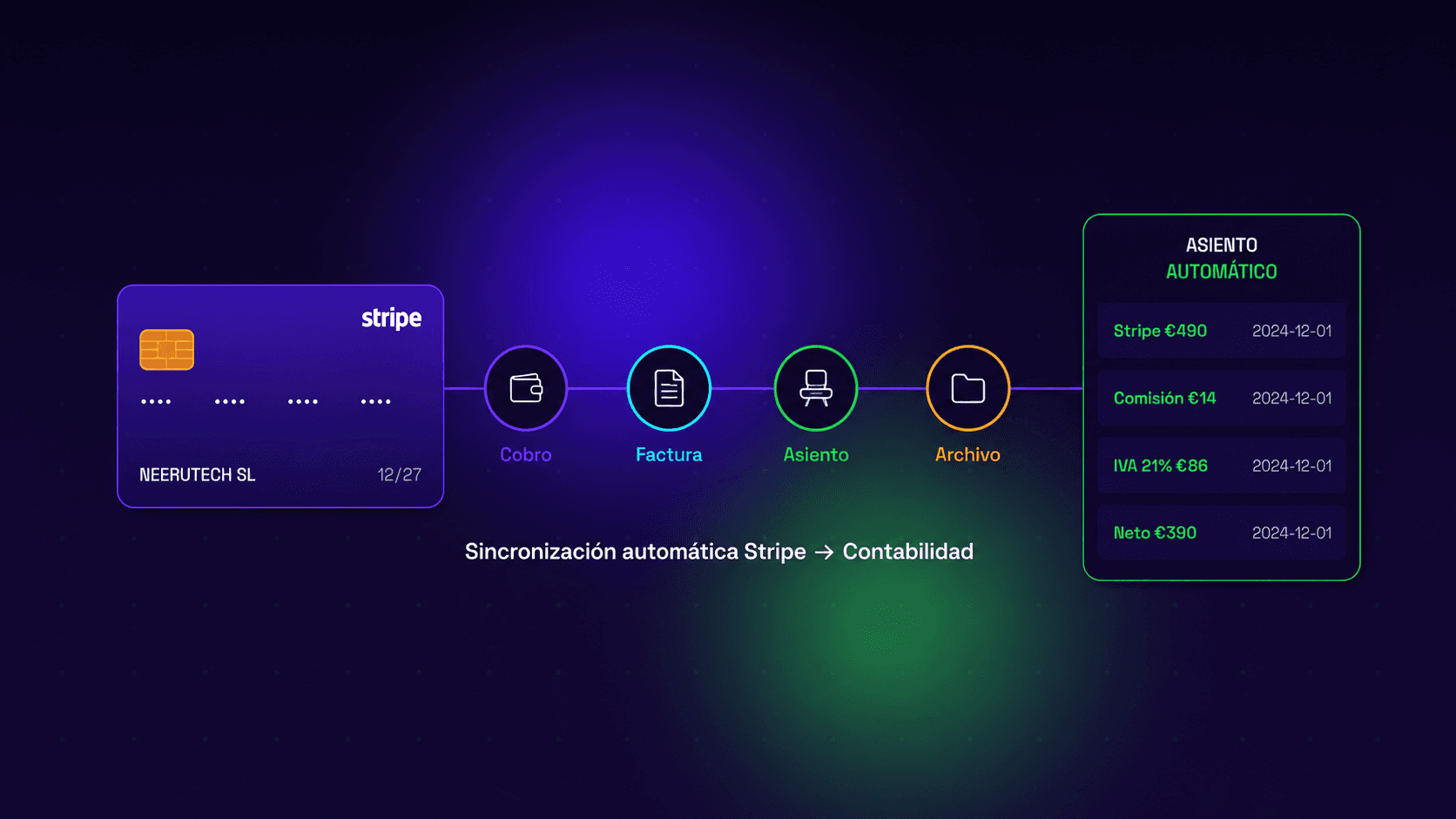
The Stripe payment gateway features beautifully engineered webhook architectures to push structured transaction payloads instantly, allowing businesses to cleanly automate downstream post-payment routines: auto-generating invoices, triggering transactional emails, or updating your CRM. In fact, that is the natural next step after integrating the gateway — we cover it in our guide on how to automate your invoicing by syncing Stripe with your accounting system.
Common Pitfalls When Integrating Payment Gateways
Accidentally exposing test credentials inside live production environments. A basic configuration oversight: transactions appear successful during testing, but real money never settles. Always validate your environmental key variables prior to driving traffic.
Misconfiguring 3D Secure fallback parameters. Under regional European PSD2 regulatory standards, Strong Customer Authentication (SCA) is a strict compliance mandate. Inaccurate webhook maps or faulty token configurations will trigger high checkout failure rates from processing banks.
Ignoring asynchronous Webhook states. If your target server fails to listen to and validate payment gateway confirmation webhooks correctly, your app may process transactions on the gateway without triggering the corresponding orders or services inside your internal DB.
Skipping real-money transaction testing before launch. Sandbox environments rarely mirror 100% of live production scenarios. Always execute minimal live financial captures with real credit cards before unlocking your site to public traffic.
Frequently Asked Questions
Can I use Redsys and Stripe at the same time?
Yes, and it is actually a highly recommended strategy. WooCommerce and most platforms let you enable both gateways and let the customer choose how to pay: Redsys for traditional buyers who trust their bank, Stripe for agile checkouts and alternative payment methods. No sale is lost over a missing payment option.
Which one is better for a small store just starting out?
Stripe, almost always. No setup fee, no monthly cost, no billing minimums, and integration within hours. Once your volume grows and stabilizes, negotiate a Redsys POS with your bank and compare: that is when switching (or combining both) may start to pay off.
How much does a Redsys virtual POS actually cost?
It depends on your bank, since Redsys does not set the rates. As a market reference: per-transaction fees between 0.3% (negotiated, high volume) and 1.5%, a setup fee of roughly €100-120, and around €20/month in maintenance or minimum billing thresholds. Always negotiate — the initial terms are rarely your bank's best offer.
Do I need a Spanish bank account for each gateway?
For Redsys, yes: you contract it through your banking institution, which issues the virtual POS. For Stripe, no bank intermediary is needed: onboarding is 100% online, and you only need an account to receive your payouts.
Can I charge subscriptions with Redsys?
Yes, through recurring card-on-file payments (COF), but it requires additional configuration and not all banks enable it the same way. If subscriptions are the heart of your business (SaaS, memberships), Stripe handles them natively and is the more solid option.
Conclusion
Redsys and Stripe do not compete as direct functional equivalents; they serve separate operational paradigms. Redsys represents a traditional, bank-backed merchant tool that commands deep localized authority among conservative demographics in Spain. Stripe is an agile, developer-first engine designed for rapid deployment, cross-border scale, and high-growth internet companies.
If you are torn between both choices, the optimal solution for scaling companies is simple: many businesses deploy both. You can route Redsys for buyers preferring traditional banking setups and run Stripe to handle alternative payment formats and modern checkouts. You do not have to compromise.
The singular critical requirement is that your technical execution must be flawless. A poorly configured payment gateway — whether built on Redsys or Stripe — generates checkout friction, triggers processing errors, and directly destroys business revenue.
At NeeruTech, we design and implement custom online payment gateways across enterprise corporate platforms and high-volume e-commerce applications, managing everything from technical API alignment to automated post-payment workflows with invoicing tools and CRM ecosystems. If you are ready to perfect your payment architecture, let's talk.
Bridge Your Payment Tools and Eliminate Abandoned Checkouts
A friction-heavy payment flow or a broken banking redirection page acts as an invisible bottleneck that destroys your website's conversion rates. The true operational power of platforms like Redsys and Stripe is unlocked when their transactional data streams, error fallbacks, and webhooks connect directly with your core ledger systems and CRM environments via robust, custom-engineered API pipelines.
Stop losing transaction volume at the final step. Explore our specialized services in systems integration and custom API connections and place your online checkout architecture on absolute autopilot.
Related articles
 Destacado
How to Integrate Stripe with Odoo and Automate Reconciliation
How to connect Stripe with Odoo: the three approaches, how to book fees and refunds, and which one fits your volume.
 Destacado
How to Automate Your Invoicing by Syncing Stripe with Your Accounting System
How to automate Stripe bank reconciliation and sync your payments with Odoo, QuickBooks or your accounting software — no manual CSV exports.
 Destacado
How Much a Website Costs for a Small Business in Spain
Orientative price ranges for a small business website in Spain, what drives the budget, what's usually included and what it costs to maintain each month.