How Much a Website Costs for a Small Business in Spain
Orientative price ranges for a small business website in Spain, what drives the budget, what's usually included and what it costs to maintain each month.
Search for "how much does a website cost" and you'll find dozens of agency pages that never answer the question. They all say the same thing: it depends on the project, every case is unique, tell us your idea and we'll send you a quote.
It does depend. But it's also a convenient excuse: if you don't publish prices, the client has to call you to find out whether they can afford it — and at that point you're already inside their decision process.
This article does the opposite. Orientative ranges, what moves the price within each range, and above all what tends to fall outside the quote — which is where the expensive surprises live.
Table of contents
- Orientative ranges
- What actually drives the price
- What's usually included and what isn't
- The monthly cost almost nobody calculates
- Signs of a quote that will get expensive
- How to request quotes you can actually compare
- Frequently asked questions
- Conclusion
Orientative ranges
These are market ranges for small businesses in Spain. They're there to tell you whether your budget fits, not to close a price:
| Type of project | Orientative range |
|---|---|
| Landing or one-page site | €500 – €1,200 |
| Corporate website (5-10 pages) | €1,200 – €3,000 |
| Standard online shop | €2,500 – €6,000 |
| Custom development | From €3,000 upwards |
Two warnings about that table.
The lower end assumes you provide the content. If you also need someone to write the copy and source the photos, add to it.
The top of each band isn't "the same but better." It usually means more functionality: bookings, a client area, integrations with your systems. If two quotes for the same thing are far apart, don't assume one is overcharging — they're almost always quoting different things.
If you're deciding between WordPress and a bespoke build, we cover that comparison separately in WordPress or custom development.
What actually drives the price
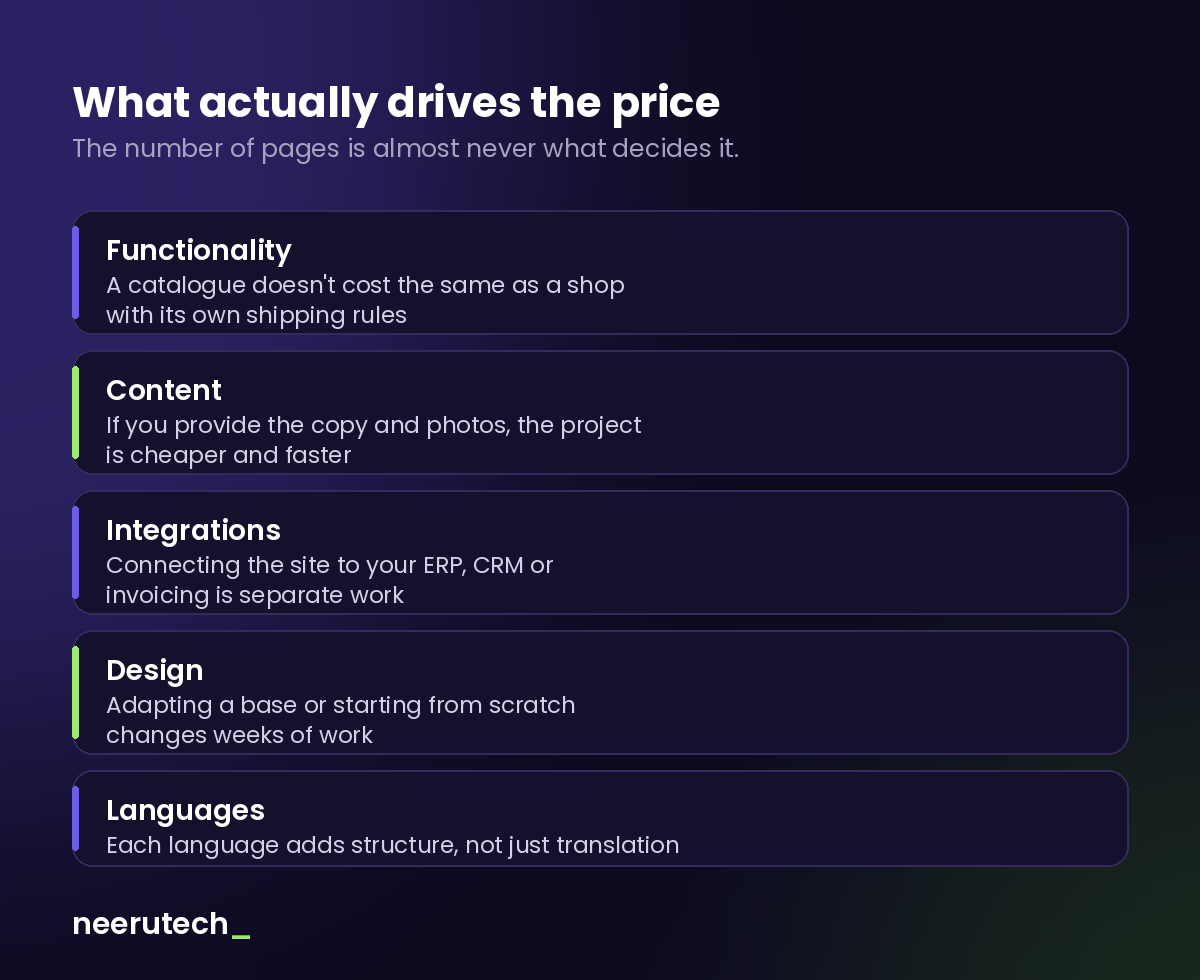
Almost everyone asks "how much does a site with X pages cost?". The number of pages is one of the least influential factors: twenty pages of the same type are nearly the same work as five.
What really moves the budget is something else:
Functionality. A catalogue that just displays products doesn't cost the same as a shop with its own shipping rules, volume discounts or different prices per customer. This is where quotes genuinely diverge.
Content. If you hand over written copy and finished photos, the project moves faster and costs less. If it all has to be created, that's separate work — and usually what delays projects most, because it depends on someone on your team sitting down to write.
Integrations. Connecting the site to your ERP, CRM or invoicing system is development, not configuration. We cover it in detail in our articles on integrations, but as a rule: if the site has to talk to another system, that's quoted separately.
Design. Adapting an existing base to your brand isn't the same as designing every screen from scratch. Both are legitimate; the difference is weeks of work.
Languages. Each language adds structure, URLs and ongoing maintenance. It isn't just translating text once.
What's usually included and what isn't
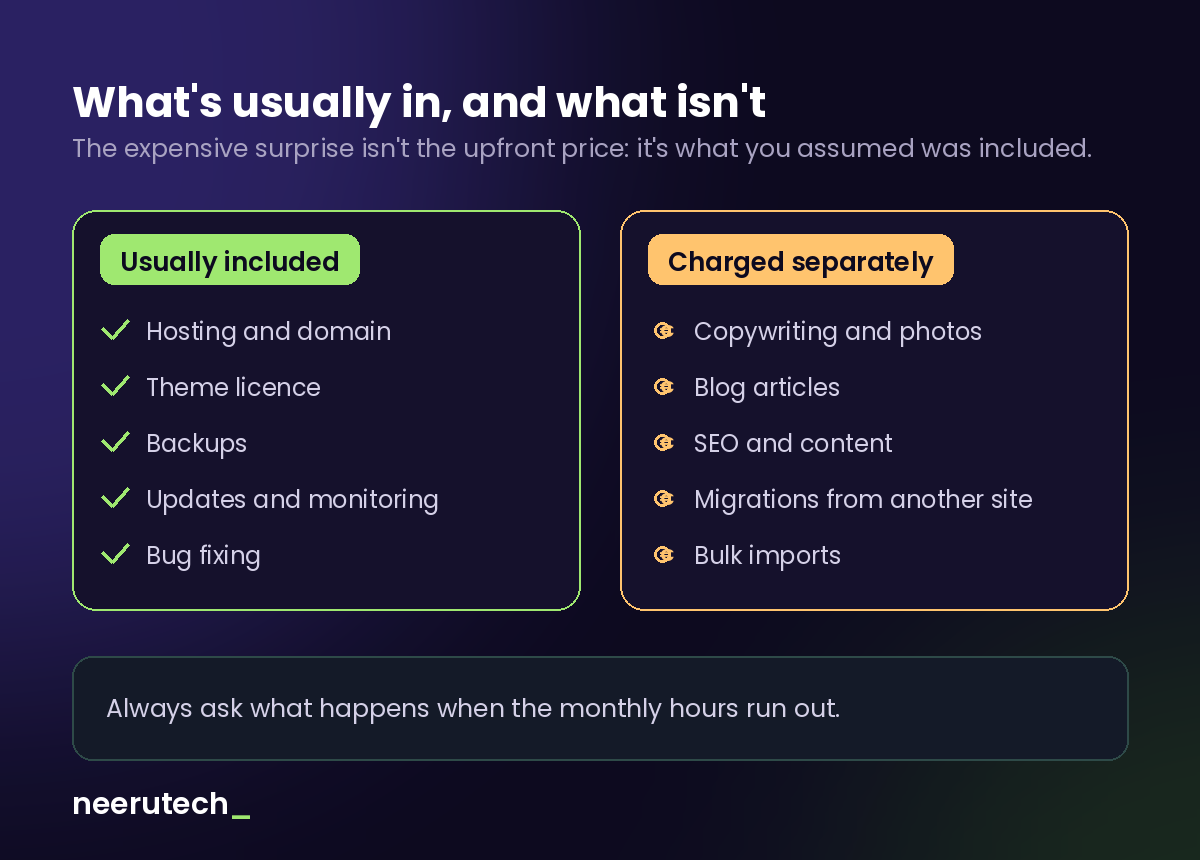
This is the part that produces awkward conversations three months after launch. The boundaries vary between providers, but the usual split is this:
Usually included: hosting and domain (first year), the theme or builder licence, backups, platform and plugin updates, monitoring, and bug fixing.
Almost always charged separately: copywriting and photography, blog articles, SEO work, migrations from another site, and bulk imports of products or data.
That second block is what catches people out. Many quotes include "website with blog" and the client assumes the articles come with it; what comes with it is the section to publish them in. Same with SEO: a technically well-built site doesn't mean someone is working on its rankings.
One distinction worth demanding in writing: a bug is not a request. If something breaks — a form that stops sending, a page throwing an error — that should be fixed without eating into your hours, because you didn't ask for it. At Neerutech we separate it explicitly: bugs are fixed without counting time; change requests consume the monthly hours.
The monthly cost almost nobody calculates
A website isn't a purchase, it's a subscription with a big upfront payment. Maintenance in the Spanish small-business market runs between €40 and €200 a month, and the difference comes down to two things: how much support is included and how many hours of changes you get.
An example of how it can be structured, using our own model: managed hosting, licences, backups, updates and monitoring, plus two monthly hours for simple requests — changing text, uploading products, updating prices, adapting a section for a seasonal campaign. Bugs are fixed separately, without eating into those hours. If you need more, extra hours can be arranged.
The number itself matters less than this: ask what happens when the hours run out. A €40 plan with no change hours and a €120 plan with three aren't comparable, even though both are called maintenance.
And a warning: if a provider doesn't mention maintenance in the quote, it isn't free. It's that you haven't had that conversation yet. We wrote about why this matters in website maintenance isn't optional.
Signs of a quote that will get expensive
Not expensive in price: expensive in headaches.
It doesn't say what happens after launch. If the document ends the day the site goes live, maintenance is a future negotiation where you'll have less leverage.
It isn't clear how you leave if you leave. Many agencies host their clients' sites on their own infrastructure, and that's perfectly reasonable: it allows centralised maintenance and a single point of contact when something breaks. The problem isn't that the hosting belongs to the provider, it's that there's no way out. Ask before signing: if I leave, do you hand over a full copy of the site and database? Is the domain in my name? Will you help with the migration? If all three answers are yes, agency hosting works in your favour. If any is no, that's where the problem is.
It doesn't state who owns the code and the domain. They should be yours, always, and registered in your name.
It's suspiciously cheap. A corporate website for €300 means an unadapted template, no support and nobody there when it breaks. That's not a bargain, it's a deferred problem.
Everything is one closed line item with no breakdown. "Web design and development: €4,500" doesn't let you compare anything or know what you're paying for.
How to request quotes you can actually compare
The most common mistake is asking for "a quote for a website". Every agency understands something different and you end up comparing incomparable things. Send everyone the same brief with this:
- What the site has to do, not how it should look. "Customers can book an appointment and it lands in my calendar" is useful; "modern and professional" isn't.
- Who provides the content. Copy and photos — say clearly whether you're supplying them.
- Which systems it has to connect to, if any.
- How many languages.
- Who will edit it afterwards and how often.
And ask the quote to answer these four questions explicitly: what maintenance includes, whose name the domain and hosting are in, what happens if I move to another provider, and what an extra hour of work costs.
With that, three quotes become genuinely comparable.
Frequently asked questions
Why don't agencies publish prices? Two reasons. One legitimate: the real range is wide and a single figure can mislead. One less legitimate: if you have to call to find out the price, you've already entered their sales funnel.
Can a €500 website be worth it? For a simple landing page, with your own content and no special functionality, yes. For a company website meant to bring in clients, that budget almost always means something important is missing: support, real customisation, or someone who answers when it breaks.
How long does it take? A corporate website usually takes three to six weeks once content exists. The factor that delays projects most isn't development: it's waiting for the client's copy and photos.
Is Wix or Squarespace cheaper? Upfront yes, but you pay an indefinite monthly fee and your site lives inside that platform. For a minimal presence it can be enough; if your business depends on the site, it runs out of room sooner than you'd think.
What if I already have a site and just want to improve it? That's usually cheaper than rebuilding, as long as the foundation is sound. What doesn't pay off is patching a site with years of accumulated plugins: at that point the fix costs more than starting over.
Conclusion
For most cases, a small business website in Spain sits between €1,200 and €6,000 upfront, plus €40 to €200 a month. Within those ranges, what decides is functionality, who provides the content, and how many systems it has to talk to.
But the number you should be looking at isn't the upfront quote: it's the three-year one. That's where you find out whether you bought a website or a nicely designed problem.
And if a provider can't give you an orientative range without a meeting first, that's already information about what working with them will be like.
Want a range for your specific case?
At Neerutech we work with WordPress and managed hosting and with custom development, so we can tell you which fits your budget without pushing you towards whatever we bill most.
Tell us what your site needs to do and we'll give you a range before any meeting.
Are you collecting quotes right now? Share this article with whoever has to decide with you.
Related articles
 Destacado
When to Leave Excel Behind: Signs Your Business Needs Something Else
The signs your business has outgrown the spreadsheet, the three steps before commissioning custom software, and how to switch without breaking anything.
 Destacado
WordPress or Custom Development: Which One Fits Your Business
An honest comparison of WordPress and custom development: self-editing, portability, total cost and when each option fits a small business.
 Destacado
Woocommerce: Why Build Your Online Store with it
WooCommerce online store: Discover why it is the most flexible and powerful e-commerce solution to scale your business sales and integrations.