Anyone Can Have a Website Today. Making It Grow Your Business Is Another Story
A website alone won’t grow a business. Combine security, Google Ads campaigns and CRO to attract people looking for what you sell and turn them into customers.
These days, building a website is within anyone's reach. There are templates, visual builders and AI tools that will give you something presentable in an afternoon.
But having a website and having a website that brings in customers are two very different things. A site can look stunning and still not generate a single quote request for months.
In this article we explain why that happens, and how we approach the work at Neerutech so a website stops being just a presence on the internet and becomes a growth tool.
Three pieces that need each other
When a website doesn't deliver results, one of these three things is almost always failing:
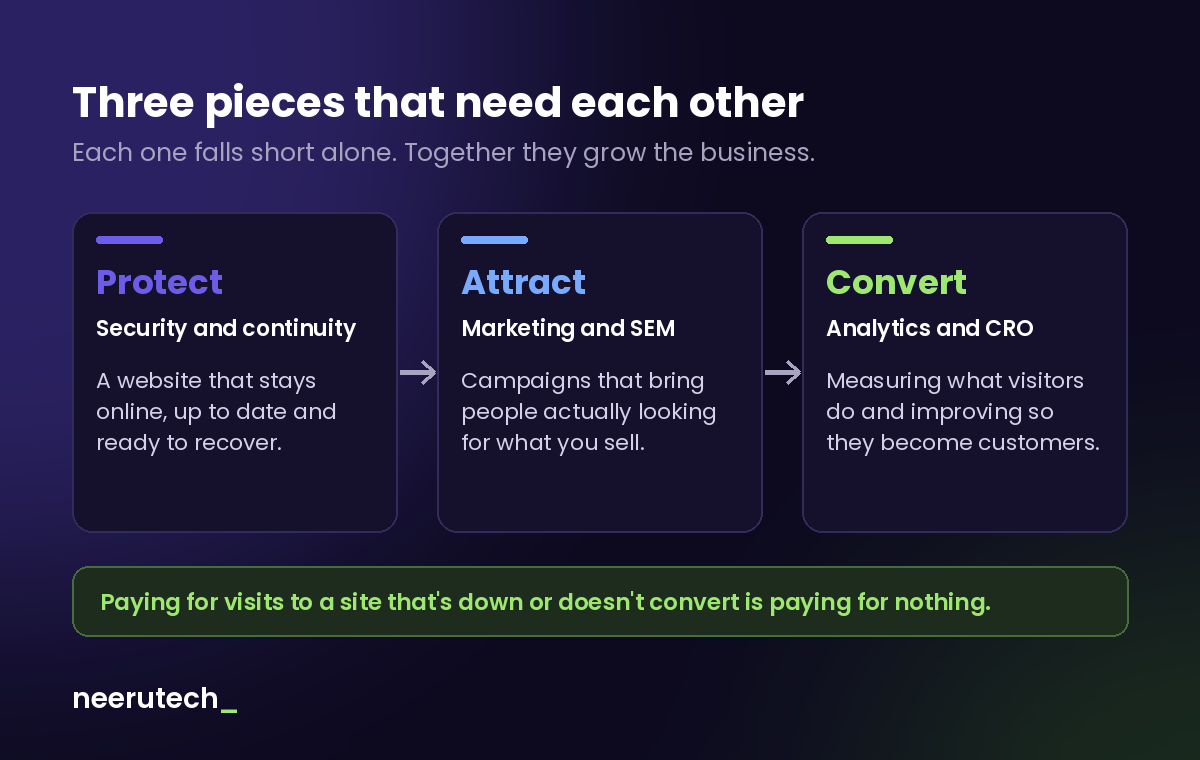
- Protect: the site stays online, up to date and ready to recover if something goes wrong.
- Attract: the people who arrive are actually looking for what you sell.
- Convert: once they're there, they do what your business needs: request a quote, book or buy.
The problem is that these are often handled separately, or only one of them gets any attention. And each one falls short on its own:
- A secure, good-looking website that nobody visits doesn't sell.
- A campaign that sends visitors to a slow, broken or confusing website is money down the drain.
- Optimising conversions without enough traffic means optimising on very little data.
Sending visitors to a website that isn't ready for them is, quite literally, paying for nothing.
Protect: the foundation nobody sees
We covered security in depth in what a small business needs to be ready when its website fails. Here, just one idea: once you're investing in campaigns, website availability stops being a technical issue and becomes a money issue.
Every hour your site is down while ads keep running, you're paying for clicks that lead to a page that won't load. That's why monitoring and a recovery plan are the foundation for everything else.
Attract: what SEM is and why it works (when done well)
SEM (Search Engine Marketing) is advertising on search engines. In practice, in Spain, it mostly means Google Ads search campaigns: ads that appear when someone searches for something specific on Google.
Its big advantage over other channels is intent. Someone searching for "boiler repair in Getafe" isn't browsing: they have a problem and want someone to fix it now. Reaching that person at that moment is worth a lot.
But that same advantage means a poorly set-up campaign burns through the budget very quickly. And the problem is rarely just the ad.
Where the budget leaks
A campaign is a chain, and it can break at any link:
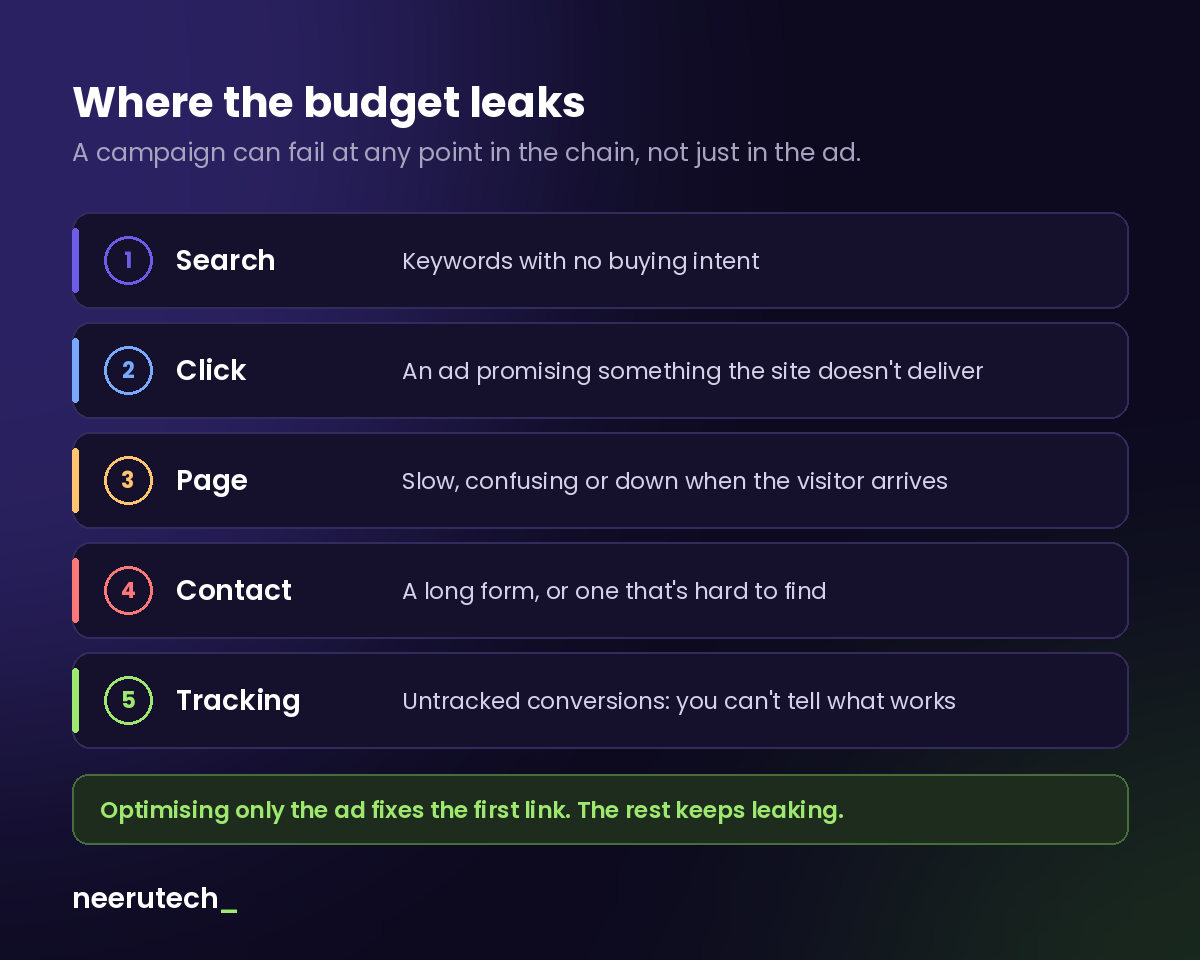
1. The search. Overly broad keywords attract people who won't buy: those looking for information, jobs or something free. Choosing the right keywords and excluding the irrelevant ones (known as negative keywords) is the first way to save money.
2. The click. If the ad promises "a quote within 24 hours" and the website doesn't mention it anywhere, the visitor leaves. The ad and the page it leads to need to tell the same story.
3. The page. Sending all traffic to the homepage is usually a mistake. A page built for that specific search works better: fast on mobile, with a clear message and a single main action.
4. The contact. Forms with too many fields, phone numbers you can't tap, or a contact button buried at the bottom of the page. This is where many almost-won opportunities get lost.
5. Tracking. If you don't track which clicks end in a contact, Google Ads can't optimise and you can't tell which keywords, ads or campaigns work. It's like driving at night with the headlights off.
Optimising only the ad fixes the first link. The rest keeps leaking.
Convert: measure to improve
This is where everything connects: analytics and CRO. We covered this in detail in how to use GA4, Clarity and Looker Studio to make data-driven decisions.
The key idea is that campaigns and the website feed each other:
- Analytics tells you which campaigns bring visitors who convert and which only add clicks.
- Clarity shows you what visitors coming from ads actually do on the page.
- With that information you improve the page, and when the page converts better, every euro spent on ads goes further.
That's where an integrated strategy makes the difference compared with hiring each piece separately.
How we work at Neerutech
We don't start with the campaign. We start by understanding the business:
- Goals: what the business needs. More quotes, more bookings, more sales? From what kind of customer?
- Foundation review: making sure the website is ready to receive traffic. Secure, fast and with the right pages.
- Tracking: setting up conversions before launching anything, so you know what works from day one.
- Campaigns: searches with real intent, ads consistent with the landing page and a budget sized for what can be learned at the start.
- Ongoing optimisation: reviewing data, improving campaigns and pages, and measuring again.
All adapted to each business's goals, needs and budget. Not every company needs everything from day one.
Conclusion
It's not about getting more visitors. It's about attracting the right audience, giving them a good experience and getting them to do what helps your business grow.
A website is the starting point, not the destination. What turns it into a growth tool is everything around it: keeping it protected, bringing in the right people, and measuring and improving continuously.
Frequently asked questions
How much do I need to invest in Google Ads to start? It depends heavily on your sector and on competition in your area. The sensible approach is to start with a budget that lets you learn (which keywords work and what a lead costs) and scale based on data, not assumptions.
SEM or SEO: which is better? They don't compete. SEO brings organic traffic in the medium and long term; SEM gives immediate visibility while SEO matures. Many small businesses combine both.
Can I run campaigns if my website is old? You can, but it's worth first checking that it loads well on mobile, has a suitable page for each service you advertise, and can track contacts. Otherwise, the campaign pays the price for those gaps.
Why isn't it enough to hire someone just for the campaigns? Because the result depends on the whole chain. An excellent campaign that leads to a page that doesn't convert delivers poor results, and the ad is almost never to blame.
Is your website working for your business, or is it just sitting on the internet?
At Neerutech we support you every step of the way: we keep your website protected and online, design campaigns to attract people looking for what you sell, and measure and optimise so those visitors become customers. See how we work.
Have you ever tried Google Ads and felt the money disappear without knowing where it went? Let us know in the comments.
Related articles
 Destacado
You Have Website Visitors, But Do You Know What They Do? GA4, Clarity and Looker Studio for Data-Driven Decisions
How to combine GA4, Microsoft Clarity and Looker Studio to understand what your visitors do, spot where they drop off and improve conversions with data.
 Destacado
What a Small Business Needs to Be Ready When Its Website Fails
How to prepare your small business website for outages, attacks or human error: tested backups, monitoring, an incident plan and a clear recovery process.
 Destacado
When to Leave Excel Behind: Signs Your Business Needs Something Else
The signs your business has outgrown the spreadsheet, the three steps before commissioning custom software, and how to switch without breaking anything.